The Reality of Private Equity K-1s: Complexity, Timing, and Investor Strategy
My name is Michiko, and I co-manage a real estate investment fund. February marks the beginning of tax season. Today, I’d like to discuss how to handle K-1 tax reporting as a real estate investor.
What Is a K-1?
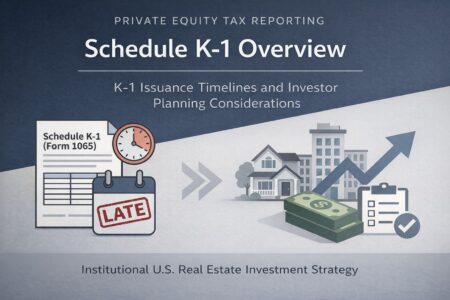
If you invest in a partnership such as a residential private equity fund, you will receive a K-1 from your general partner. Its official name is Schedule K-1 (Form 1065). It reports each partner’s allocated share of income from the partnership.
If you invest in stocks, you will typically receive Form 1099-DIV from your broker, which reports dividends paid during the tax year. Property owners who use a property manager may receive Form 1099-MISC, which reports the gross rental income collected.
A K-1 is much more detailed. It allocates various items — income, expenses, depreciation, interest, and more — according to each investor’s ownership share.
In the case of our fund, the first year, 2024, was not very complicated; we simply purchased and repaired properties, with almost no rental income. From 2025 onwards, our activities became more complex, and filings are becoming more detailed to reflect this.
The good thing about fund investing is that individual investors, or limited partners, do not have to handle the complicated real estate management and tax filing themselves. This is what makes real estate fund investment different — and, in our opinion, better — from being a direct real estate investor.
Why Fund Investing Is Different from Individual Investing
By 2025, Mutual Trust Management Advisors was implementing investment strategies that would have been nearly impossible for individual investors. For example, the fund was able to discreetly acquire exceptional portfolios from distressed sellers — transactions requiring capital that would normally necessitate a loan for an individual investor, with due diligence on dozens of properties carried out in a short span of time.
Large-scale real estate transactions require a different approach from typical deals — involving techniques such as acquiring the company that holds the property, conducting corporate due diligence, and coordinating legal and financial professionals. These transactions generally go beyond what a real estate agent can support, and the buyer must take full command of the process.
When acquiring an existing portfolio, a repair reserve is typically required, meaning the buyer should expect additional expenses immediately post-acquisition.
The appeal of fund investing lies in giving individual investors access to opportunities that would otherwise require significant time, capital, and expertise to pursue independently — pooling resources and placing them under professional management.
Why Fund Tax Filings Are More Complex
This operational complexity directly translates into tax reporting complexity.
A fund such as ours requires a robust system to track documentation for every property — and this becomes increasingly complex as we acquire more single-family rentals. Depreciation must be calculated for each property separately. Repair expenses must be properly reclassified. Final income statements must be submitted both per ownership entity and in aggregate.
Timing is another challenge. Final management reports for December are typically available in January, and November and December reconciliations often extend into February — the busiest period for accountants.
The fund must carefully evaluate the proper allocation of gains and losses under the partnership agreement and applicable tax rules. In some cases, the partnership may file for an extension to allow additional time for reconciliation and analysis. For example, decisions such as whether to conduct a cost segregation study or apply standard depreciation may require further review before finalizing the return.
As fund operations become more complex, the information reflected in the K-1 becomes increasingly powerful as a tool for long-term tax planning and wealth strategy. Delays in issuing a K-1 are often the result of deliberate decisions to ensure accuracy and proper reporting.
What Should K-1 Investors Do?
Investors accustomed to standard tax filing may expect to begin preparing in January and file by April 15 — which is also why the standard delivery deadline for Form 1099-MISC is January 31. For K-1 investors, however, the recommended approach is often to be prepared to file for an extension.
Under IRS safe harbor rules, paying a sufficient amount based on prior-year tax liability can help avoid underpayment penalties. Consult your tax advisor for details specific to your situation.
Important Note for Class A Investors
Class A investors who receive no distributions may not feel the immediate impact of a delay. However, failing to report K-1 information can create long-term complications. Basis and passive loss tracking may become inconsistent if prior-year information is not properly reflected — affecting the accuracy of future distributions, gain calculations upon sale, and overall tax reporting.
A Long-Term View
Private equity investing comes with complexity, and K-1 timing reflects that reality. Understanding how partnership tax reporting works allows investors to approach filing season with clarity rather than frustration. As operations scale and strategies evolve, thoughtful reporting becomes part of the long-term discipline that supports sustainable wealth building.